


4″ ENVIROFLEX®
| ENVIROFLEX® ACB TRAPEZOIDAL CHANNEL DETAILS |

|
| ENVIROFLEX® ACB SIDE SLOPE LINED CHANNEL |
|
| ENVIROFLEX® ACB COMPOUND CHANNEL |
|
| ENVIROFLEX® ACB CHANNEL WITH VERDURA® RETAINING WALL |
|
| ENVIROFLEX® ACB CHANNEL SECTION AT BRIDGE/PIER STRUCTURE |
|
| ENVIROFLEX® ACB BASIN ACCESS ROAD |
|
6” ENVIROFLEX®
| ENVIROFLEX® ACB TRAPEZOIDAL CHANNEL DETAILS |
|
| ENVIROFLEX® ACB SIDE SLOPE LINED CHANNEL |
|
| ENVIROFLEX® ACB COMPOUND CHANNEL |
|
| ENVIROFLEX® ACB CHANNEL WITH VERDURA® RETAINING WALL |
|
| ENVIROFLEX® ACB CHANNEL SECTION AT BRIDGE/PIER STRUCTURE |
|
| ENVIROFLEX® ACB BASIN ACCESS ROAD |
|
ENVIROFLEX® Connection and Perimeter Details
| Enviroflex® ACB Perimeter Edge Options |
|
| Enviroflex® Connection Options |
|
Resources
| ENVIROFLEX® PRODUCT BROCHURE |
|
| ENVIROFLEX® OPERATION AND MAINTENANCE MANUAL |
|
Design
| ENVIROFLEX® - PAVEMENT CALCULATION WORKSHEET |
|
Specifications
| ENVIROFLEX® MASTER SPEC |
|
Installation
| Enviroflex® – Articulating Concrete Block (ACB) – Installation Steps |
|
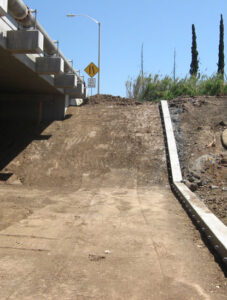 Step 1
Prepare the Area
The subgrade is prepared per the project requirements. Cut-off walls are installed as specified by the engineer.
Step 1
Prepare the Area
The subgrade is prepared per the project requirements. Cut-off walls are installed as specified by the engineer.
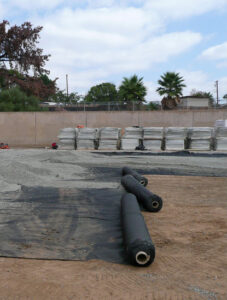 Step 2
Install the Filter Fabric
Install the appropriate filter fabric as specified on the drawings. If a drainage layer is required, it may be placed concurrently to keep the fabric in place.
Step 2
Install the Filter Fabric
Install the appropriate filter fabric as specified on the drawings. If a drainage layer is required, it may be placed concurrently to keep the fabric in place.
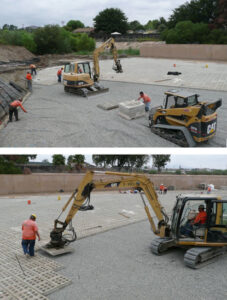 Step 3
Place the Block
Blocks are either hand-placed or placed with a grappling attachment on an excavator. Please contact us for rental information.
Step 3
Place the Block
Blocks are either hand-placed or placed with a grappling attachment on an excavator. Please contact us for rental information.
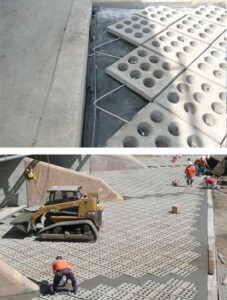 Step 4
Closure Pours
On terminal ends and areas where Enviroflex® abuts existing structures, concrete is typically poured to finish the area. The concrete should be reinforced, have the same strength as the block, and typically be at least 6 inches wide.
Step 4
Closure Pours
On terminal ends and areas where Enviroflex® abuts existing structures, concrete is typically poured to finish the area. The concrete should be reinforced, have the same strength as the block, and typically be at least 6 inches wide.
 Step 5
Infill
The open cells of Enviroflex® are either backfilled with suitable soil for vegetation, with 3/4 inch diameter crushed stone, or left bare.
Step 5
Infill
The open cells of Enviroflex® are either backfilled with suitable soil for vegetation, with 3/4 inch diameter crushed stone, or left bare.